Valencia kitchens on both sides of the 1994 fixture line
One build year decides how far a permitted kitchen remodel reaches into the rest of the house. Valencia has the city's oldest ZIP area and its newest, so the answer here depends on which street you are on.
Checked September 22, 2026, at the statutes, City pages and Assessor roll listed at the end.
Disclosure: this site makes introductions. It holds no contractor license and sets no prices. How this works
Short answer
California's water conserving fixture rule applies to property "built and available for use on or before January 1, 1994." In a detached house that old, a permitted alteration ends with every noncompliant toilet, showerhead and interior faucet in the house replaced before final approval, unless an exemption applies. In a newer house the rule does not reach it at all, and the year on the Assessor record decides which you are (Civil Code 1101.2, Civil Code 1101.4).
Stage 04 of 06, where this sits
Two ZIP areas, opposite sides of one year
On the County Assessor's 2026 roll, 6,218 of the 7,328 detached houses inside the city in the 91355 ZIP code area carry a build year of 1993 or earlier. At 84.9 percent that is the highest share of the seven ZIP areas. In 91354 it is 2,848 of 8,250, or 34.5 percent, the lowest (LA County Assessor parcel layer).
Attached homes split the same way. Of the condo coded parcels, 2,288 of 3,069 in 91355 carry a year of 1993 or earlier, while none of the 1,814 in 91354 does; its earliest is 1995 (LA County Assessor parcel layer).
A ZIP area is drawn for mail delivery and follows no neighborhood boundary, and the Assessor's year is the recorded year for the main building. The statute's test is different wording, so treat the table as the shape of the area and check your own record (LA County Assessor parcel layer).
Get a written price
Free to you. The contractor calls to set a visit.
| ZIP code area | Detached houses | Built 1993 or earlier |
|---|---|---|
| 91355 | 7,328 | 84.9 percent |
| 91321 | 4,432 | 81.0 percent |
| 91351 | 5,566 | 75.3 percent |
| 91350 | 11,045 | 56.1 percent |
| 91387 | 7,179 | 53.1 percent |
| 91390 | 3,466 | 38.6 percent |
| 91354 | 8,250 | 34.5 percent |
What that year switches on
Except as its own exemptions provide, the article applies to "residential and commercial real property built and available for use on or before January 1, 1994" (Civil Code 1101.2).
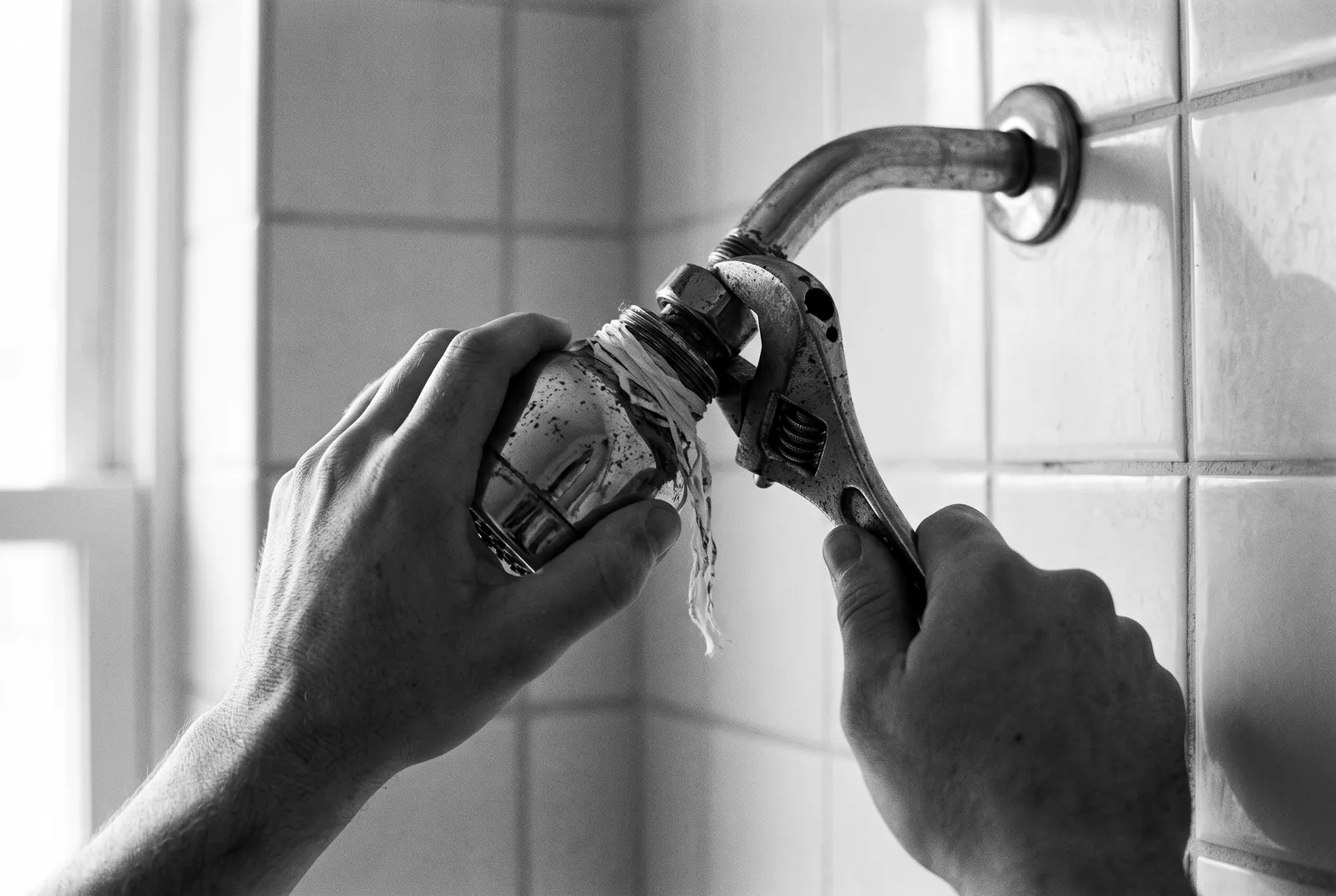
For a detached house: "For all building alterations or improvements to single-family residential real property, as a condition for issuance of a certificate of final completion and occupancy or final permit approval by the local building department, the permit applicant shall replace all noncompliant plumbing fixtures with water-conserving plumbing fixtures" (Civil Code 1101.4).
Noncompliant is defined: a toilet manufactured to use more than 1.6 gallons per flush, a showerhead rated above 2.5 gallons per minute, and "Any interior faucet that emits more than 2.2 gallons of water per minute" (Civil Code 1101.3). The rule reaches the whole house, so a kitchen quote for a pre-1994 house should carry it.
What the City tells permit applicants
The City's Building and Safety notices page states the duty plainly: Senate Bill 407 "requires a building permit applicant to replace all noncompliant plumbing fixtures in properties built and available for use on or before January 1, 1994, with water-conserving plumbing fixtures as a condition for approval of a final building permit for building alterations or improvements" (City public notices page).
Its handout adds the City's own reading: the rule "only applies to additions or remodels/alterations to existing residential or commercial buildings built and available for use on or before January 1, 1994," while "Construction related to repairs or maintenance of the structure is not considered to be an alteration or improvement" (City SB 407 handout).
The same rule, with its definitions and the exemption question, sits on the code requirements page.
Next in the sequence
Keep reading
An attached unit follows a room rule instead
For a building with more than one unit, the statute works room by room: "for any alterations or improvements to a room in a building that require a building permit and that room contains any noncompliant plumbing fixtures, the building permit applicant shall replace all noncompliant plumbing fixtures in that room" (Civil Code 1101.5).
The same section carries two wider triggers for these buildings: an addition of more than 10 percent of floor area, and a permit for improvements over $150,000, each reaching further than one room (Civil Code 1101.5).
So for a kitchen in a pre-1994 attached home the room rule is what points at its own fixtures. One gap is worth raising with Building and Safety before you budget: the subsection says work that requires a building permit, and in the city counters and cabinets are exempt from that permit while trade permits still apply, as the permit page sets out. How an association reviews the work is on the small and condo kitchens page.
Where the duty does not land
The statute lists exemptions: a registered historical site, a licensed plumber certifying that, because of the age or configuration of the property or its plumbing, installing the fixtures "is not technically feasible," and a building whose water service is permanently disconnected (Civil Code 1101.7).
A demolition permit postpones the duty for one year, and it returns if the building is not demolished, subject to appeal to the local building department (Civil Code 1101.6).
And the year itself is the first gate. A house the Assessor records as built after 1993 sits outside the article, which is most of the 91354 area and about one detached house in six in 91355 (LA County Assessor parcel layer).

Finding the year for your own address
The County Assessor's property portal shows the recorded year built for a parcel (LA County Assessor portal). That year, and the statute's "built and available for use" wording, is what a permit applicant works from. A share for a ZIP area says nothing about any single house.
If the year lands before 1994, treat the fixture swap as part of the kitchen budget from the first quote, and ask Building and Safety what it wants to see at final (City public notices page).
Elsewhere in the valley: Saugus and its newer houses, Newhall and rented kitchens and Canyon Country and homes in parks.
Asked about Valencia houses and the 1994 rule
Does the 1994 rule apply to my Valencia condo?
In a building with more than one unit the statute points at the room being altered, so the kitchen's own noncompliant fixtures (Civil Code 1101.5). Whether a kitchen with trade permits only triggers it is a question for Building and Safety.
How do I find the year my house was built?
The County Assessor's portal shows the recorded year for the parcel (LA County Assessor portal). The statute asks whether the property was built and available for use on or before January 1, 1994 (Civil Code 1101.2).
Is there a cost threshold before the rule applies?
Not for a detached house. The statute ties the duty to a permitted alteration and final approval, whatever the job costs (Civil Code 1101.4).
What if a fixture cannot be replaced?
The exemptions are a registered historical site, a licensed plumber certifying that installation is not technically feasible given the age or configuration of the property or its plumbing, and permanently disconnected water service (Civil Code 1101.7).
Sources
Every rule and count on this page was read in the statute, City page or Assessor roll that states it, in September 2026. A ZIP share describes an area; the year on your own record is what the rule turns on.
- 1Los Angeles County parcel layer with Assessor fields, 2026 roll (ArcGIS REST service)
- 2Civil Code section 1101.2, properties the article applies to, California Legislative Information
- 3Civil Code section 1101.4, single family residential property, California Legislative Information
- 4Civil Code section 1101.3, definitions, California Legislative Information
- 5City of Santa Clarita Building and Safety, Public Notices
- 6City of Santa Clarita, Senate Bill 407 informational handout (PDF)
- 7Civil Code section 1101.5, multifamily and commercial property, California Legislative Information
- 8Civil Code section 1101.7, exemptions, California Legislative Information
- 9Civil Code section 1101.6, demolition permits, California Legislative Information
- 10Los Angeles County Office of the Assessor, property detail portal